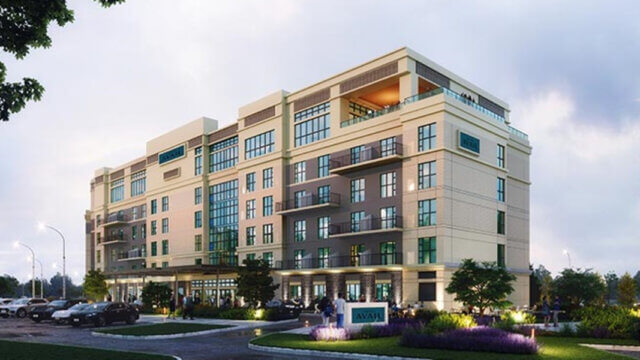
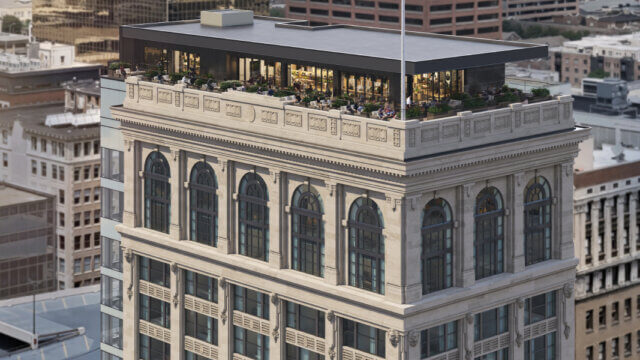
When Bashar Wali talks about The Compton, he returns to a single idea: belonging.
“We built The Compton to feel like it belongs here, not like it landed here,” said Wali, founder/CEO, Practice Hospitality, operating partner of the 142-room independent lifestyle hotel in Bentonville, AR. “Bentonville’s outdoors-first energy, its cycling culture and its tight-knit community shaped the plan from day one. We designed the hotel as a basecamp for adventure, on the Square, a place that nudges you outside, then welcomes you back in. The goal stayed simple: make a hotel that could only make sense in Bentonville.”
Opened on the city’s historic Square and developed by Blue Crane, the hotel arrives at a defining moment for Bentonville, which has evolved from corporate hub to global cycling destination and cultural center. With more than 70 miles of trails in the city and access to hundreds more across the Ozarks, Bentonville’s identity as the “Mountain Biking Capital of the World” has reshaped downtown life.

The hotel is named for conservationist Neil Compton, whose advocacy helped protect the Buffalo River as America’s first National River. “That kind of stewardship deserved more than a name on the door,” Wali said.
In the Ozark Room, a communal table etched with the path of the Buffalo River nods to Compton’s legacy. Ceiling elements reference his canoe. In the adjoining library, guests encounter Ozark folklore, flora, fauna and geology, alongside mineral specimens curated with the University of Arkansas Department of Geological Sciences.
“Guests can dig into Ozark folklore, flora, fauna and geology, a nod to the curiosity that drove his work,” Wali said.
Biophilic design drives the physical and emotional rhythm of the hotel. The guest journey begins at a covered front porch before moving into a reception area anchored by Ozark limestone. Beyond it, a two-story atrium unfolds around a sculptural bluff wall carved from locally sourced stone and inspired by the cliffs of the Buffalo River. Water flows across the limestone surface, gradually patinating it over time. A 900-sq.-ft. skylight shifts daylight across greenery and boulders, while Drift’s Fragile Future FFC Bentonville installation floats overhead.
“We treated those themes as operating principles, not wallpaper,” Wali said of nature, culture and community. “Nature shows up in Ozark-sourced limestone, natural textures and the atrium’s bluff wall inspired by the Buffalo River cliffs, with water moving across it and daylight shifting overhead.”
He describes the atrium as the emotional center of the hotel. “The atrium tells a geology story first,” he said. “Water moves across the surface as a living element that changes over time, the way the region changes. The skylight brings shifting daylight that redraws the space hour by hour, and the greenery softens the edges between indoors and out.”
The hotel’s physical expression is the result of a broad creative collaboration. Design architects Marvel Design worked alongside executive architects BRR Architecture to shape the building’s structure and presence on the Square, while interiors were led by CRÈME under Jun Aizaki, translating the Ozarks’ textures and tones into layered, tactile spaces. Landscape architecture firm Design Workshop extended that vision outdoors, using limestone hardscape and native plantings to stitch the property into Bentonville’s evolving pedestrian corridors and green network.
The guestrooms continue that indoor-outdoor dialogue. Built-in window seats replace traditional desks. Hickory millwork and green-blue accents echo Arkansas waterways. Bathrooms feature handcrafted turquoise tiles inspired by waterfalls. Foam rollers and yoga mats await riders returning from the trails.
“We designed the rooms around how people actually recover after a day in Bentonville,” Wali said. “Riders do not want another desk, they want light, a place to exhale and space to reset. Window seats do that better than a task chair ever will. We added simple recovery tools like foam rollers and yoga mats because guests use them, especially in a market built around movement. Wellness should feel practical, not performative.”
Rather than treating biking as a box to check, The Compton embedded it into operations. An on-site cycling concierge, powered by local outfitter 37 North, offers route planning, guided group rides and Saturday shuttles to major trail systems. Secure bike valet, curbside staging and post-ride hot or cold towels round out the experience.
“We treated cycling as a core part of the product, not an amenity on a checklist,” Wali said. “Guests should spend their energy on the ride, not the friction.”
That insider ethos extends beyond trails. “We do not hand guests a scripted itinerary,” he said. “We give them access, context and the right people. The Compton sits on the Bentonville Square, steps from trails, culture and the rhythm of town. Through local partnerships and on-property expertise, we steer guests toward the Ozarks as locals live it, from world-class riding to the region’s art and food. The hotel works as a home base with real guidance, not generic recommendations.”
Every evening, turndown service draws on Ozark folklore documented by regional folklorist Vance Randolph. Guests receive tokens inspired by local traditions: red string for protection, wildflower seeds for renewal, stones for grounding.
“Hotels can look great and still feel nowhere,” Wali said. “Storytelling fixes that. The Ozarks carry a deep tradition of folklore and craft, and we wanted guests to feel the place, not just photograph it. Those details give the stay texture, memory and meaning.”
Art also serves as orientation. Curated in partnership with OZ Art NWA, the collection includes works by artists such as William McNamara, Alice Andrews, Cate McCoy, Kristin Musgnug and Stephen Ironside.
“We curated work that reflects Northwest Arkansas as it looks, feels, and evolves, not as a souvenir version of itself,” he said. “The art functions as orientation. It tells you where you are without lecturing you.”
The Compton also positions itself as civic infrastructure. With nearly 15,000 sq. ft. of meeting and event space, including the Dogwood Ballroom and Gallery overlooking Dave Peel Park, the hotel is designed to host both travelers and residents. Three dining concepts operated by Indigo Road Hospitality Group further anchor it to daily life: Sestina, a Tuscan-inspired steakhouse; The Eddy, an elevated bar overlooking the Square; and Field Notes, an all-day cafe.
“We built The Compton to earn a role in local life,” Wali said. “That means spaces locals actually use, not just admire. Porchlight Sessions brings music into shared spaces, The Eddy gives the Square a place to meet, and Sestina gives locals a reason to come back for dinner. We want residents to treat the hotel as part of their routine, whether that looks like cocktails, a celebration or a staycation. A hotel that only works for travelers stays lonely.”
For Wali, collaboration was essential to achieving authenticity. “Local partners kept us honest,” he said. “They brought real knowledge and real standards, and the hotel got better because of it. You cannot fake sense of place, you have to collaborate your way into it.”