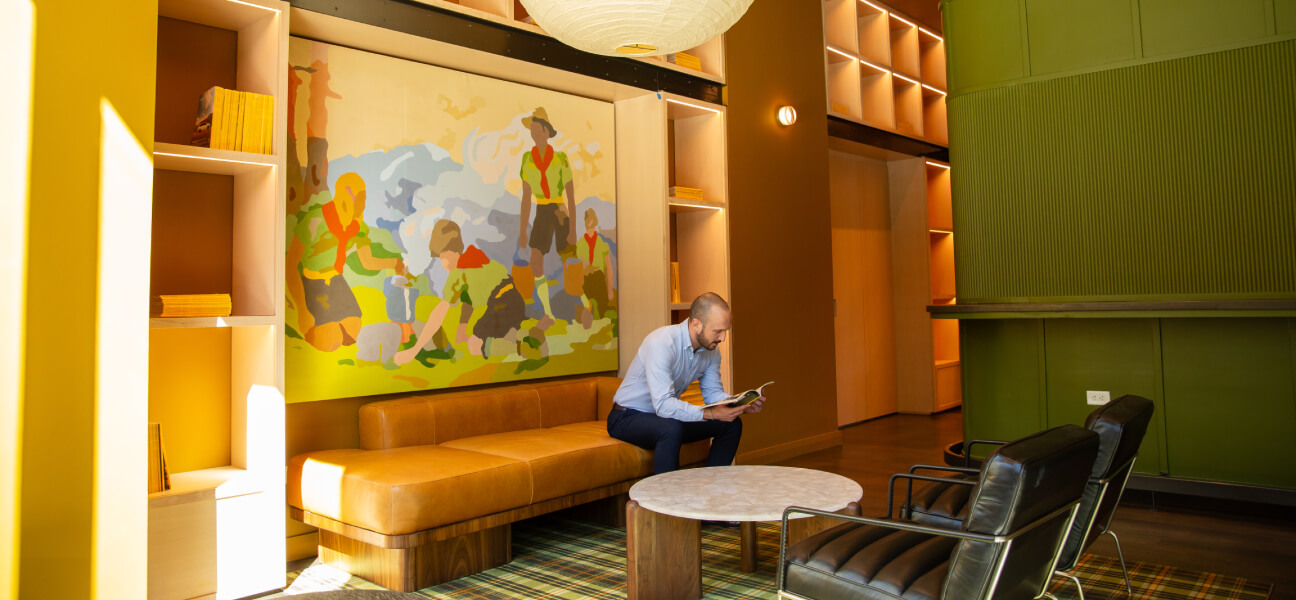
When Jamestown LP set out to create Scout Living at Ponce City Market in Atlanta, the goal was simple: to design a place where travelers and long-term residents alike could feel at home while enjoying the flexibility and convenience of a hotel. But the execution is anything but ordinary. Scout Living merges residential comfort with hospitality services, reflecting both modern lifestyles and the company’s commitment to design-driven, community-focused real estate.
Michael Phillips, president, Jamestown, and the creative mind behind Scout Living, said the concept stemmed from observing the needs of frequent travelers and young professionals. “When you travel frequently, you don’t want a big front desk experience,” he said. “You want something that’s familiar, the same room—or something that feels like the same room. Keyless entry, push notifications on your phone—it’s a residential space with a hotel overlay,” he said.
 Designed for stays ranging from a single night to an entire year, Scout Living offers 405 units, split roughly evenly between short-term and long-term accommodations. One-bedroom apartments start at $1,600 per month, a price point well below comparable shared apartments in Atlanta’s urban neighborhoods, according to Phillips. Each unit includes full amenities such as a washer, dryer and dishwasher, combining efficiency with comfort in a thoughtfully designed micro-apartment.
The concept fills a unique niche in the market. Phillips compared Scout Living to European limited-service hotels, noting that the property offers “much nicer” spaces but at a more accessible price. He stressed that the project is intentionally positioned between boutique luxury and standard limited-service hotels, offering a high-quality yet approachable environment.
“On the other side of the boutique hotel phenomenon, it’s just great to be something that’s really well designed and affordable,” he said.
A central tenet of Scout Living is flexibility. Guests can tailor their experience to their own needs, whether that’s a short corporate trip, a weekend getaway or a long-term stay. Long-term residents can even customize their apartments, bringing personal items or furnishing choices that reflect their lifestyle. Phillips recounted one resident who insisted her employment contract include Scout Living because it allowed her to live comfortably with her dog while staying embedded in the Atlanta community.
The property’s amenities further support both long-term living and short-term convenience. Scout Living includes a gym and access to a larger Forum Athletic Club with yoga studios and fitness facilities, coworking spaces, rooftop private rooms and a business center. The spaces are designed to accommodate a range of activities, from professional meetings to social gatherings, reflecting the evolving demands of today’s travelers.
Design details also set the concept apart, according to Phillips. Felt-lined hallways, cork floors, pocket doors for sleeping areas and sound-attenuating walls create a quieter, more residential feel. He explained that these features were intended to prioritize comfort and privacy. “It’s important for people to sleep well,” he said. “We cater to creative people, and we wanted to create an environment that they could feel like they were really in.”
Given its name, the concept leans into a scouting theme, inspired by explorers and adventurers who move through the world with purpose. The interiors include subtle nods to this idea, with graphics, textures, and design choices that evoke exploration and discovery. Phillips cited the boutique hotels of the 1980s as a design reference, highlighting the importance of hallways and transitional spaces as part of the guest experience.
The location at Ponce City Market further integrates Scout Living into Atlanta’s urban fabric. Housed next to a historic Sears catalog warehouse—the largest brick building in the southern U.S.—the property connects guests to the surrounding neighborhood. Retail, dining, entertainment and cultural offerings, from handmade pasta shops to weekly block parties, create a sense of place.
“The whole thing is an ecosystem,” Phillips said. “You can come there never having been a part of that community and discover it, or you can come there because you already know about it. Either way, the experience leads you to the same place.”
Jamestown owns and operates Scout Living, with property management company Placemakr overseeing day-to-day operations. The company is exploring additional sites across the U.S., with plans to eventually expand to Europe. A points program is also in development to further enhance the guest experience.
Phillips said that the concept is about more than just lodging—it is about creating a home away from home that is thoughtful, comfortable and adaptable. “We wanted people to feel like we were thoughtful, like an amazing host,” he said. “Unbelievably comfortable beds, cozy bedrooms, everything just feels right. And you don’t have to pay $1,000 a night to get that comfort.”