When the 70-room Hotel De Novo Springdale, a Tapestry Collection by Hilton hotel, reopened after an extensive renovation, it emerged not just as a refreshed property but as a carefully curated sanctuary in harmony with its surroundings. Situated near the entrance to Zion National Park, the 70-key hotel—originally built in 2003 as a rustic, Southwestern-themed lodge—was reimagined by DyeLot Interiors to meet the soft-brand’s standards while honoring the spirit of its landscape.
Jackson Thilenius, senior principal, DyeLot Interiors, said the design team made a deliberate decision to avoid the most obvious approach. “Hotel De Novo sits at the entrance to Zion National Park; it would have been easy to rely on literal references to the canyon walls,” he explained. “We wanted to avoid that and built our design narrative around the balance between the rugged surroundings and an elegant yet approachable materiality.”
To achieve this, the team turned to materials with a natural, timeworn quality. “We used materials that reflect the rawness and patina of the natural environment, including honed stone, dark bronze metals and deeply grained woods,” he said. “We worked with a warm-neutral palette that would evolve with natural daylight and emphasize the changes in the exterior views. Interior sightlines were intentionally cleared and aligned to draw the eye outward, anchoring the guest experience in the landscape from the moment of arrival to the privacy of the guestroom.”
Color played a key role in tying the hotel to its environment. “Our palette is derived from the local topography and regional geology—specifically, the desaturated warmth of Navajo sandstone, the earthy reds of the canyons and the mineral hues of river rock,” Thilenius said. “We balanced these tones with cooler, grounding elements like charcoal metal accents and weathered wood to bring in the feeling of shelter and respite.”
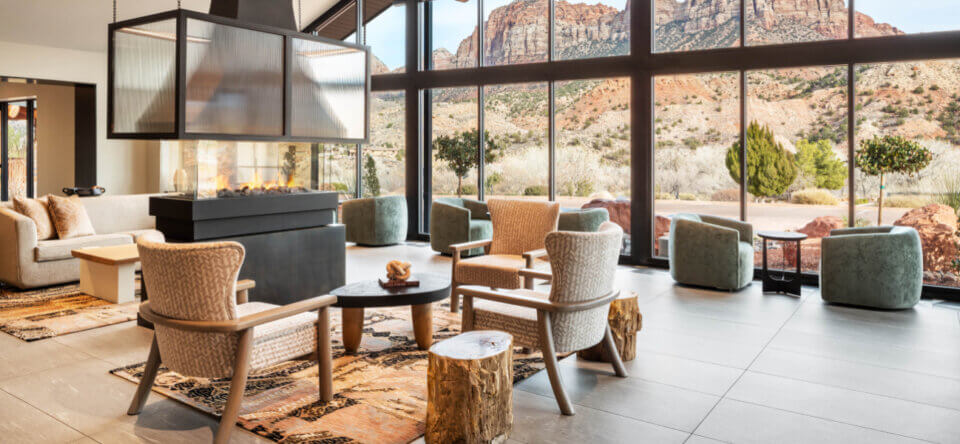
Public areas use contrast to create energy and highlight key guest touchpoints. “Warm ochres and deep desert browns are paired with luminous neutral tones,” he said. In guestrooms, the mood softens, he noted, adding, “The palette is quieter and more intimate, focused on soft beiges, dusty rose, and taupe with dark bronze and matte black hardware to provide balance and modernity.”
Even the connection between indoors and outdoors was studied. “We coordinated with the architectural team to bring the interior and exterior into conversation,” Thilenius said. “Exterior wood finishes and paint selections were tested under natural light against interior material boards to ensure a cohesive feel from arrival through to the lobby, guestrooms and outdoor common areas.”
The arrival experience was a complete rethinking of first impressions. “Originally, the arrival experience was disjointed—guests entered through an unassuming vestibule and were funneled into a narrow, dimly lit check-in area with no sense of destination or anticipation,” Thilenius said. “We completely restructured this zone to deliver a sense of arrival that feels grounded, expansive and welcoming.”
That transformation included addressing unexpected architectural challenges. “Initial exploratory demolition revealed load-bearing, immovable exterior walls bisecting planned spaces,” he said. “We found a way to reprogram the spatial volume and encased the wall timbers—salvaged from the 1988 Yellowstone fire—in glass as a design statement, turning a challenge into storytelling.”
Today, guests are greeted with a framed view of the cliffs before stepping into a lobby opened to its full height. “We designed a new reception desk carved from local stone with integrated lighting, allowing it to feel both monumental and warm,” Thilenius said. The former lobby lounge is now a multi-purpose communal space anchored by a fireplace and flexible seating. “Layers of lighting and a strategic use of materials like textured plaster and handwoven textiles create a calm but tactile environment,” he said. A subtle scent and curated playlist reinforce the atmosphere as “a sanctuary after adventure.”
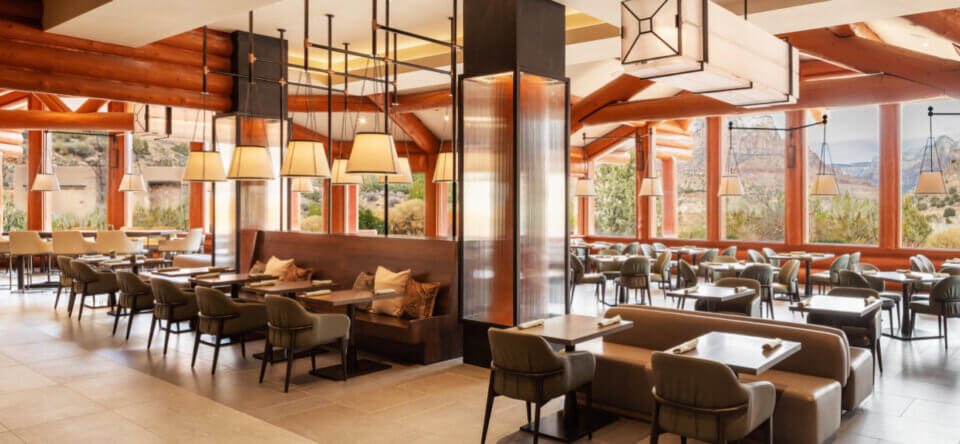
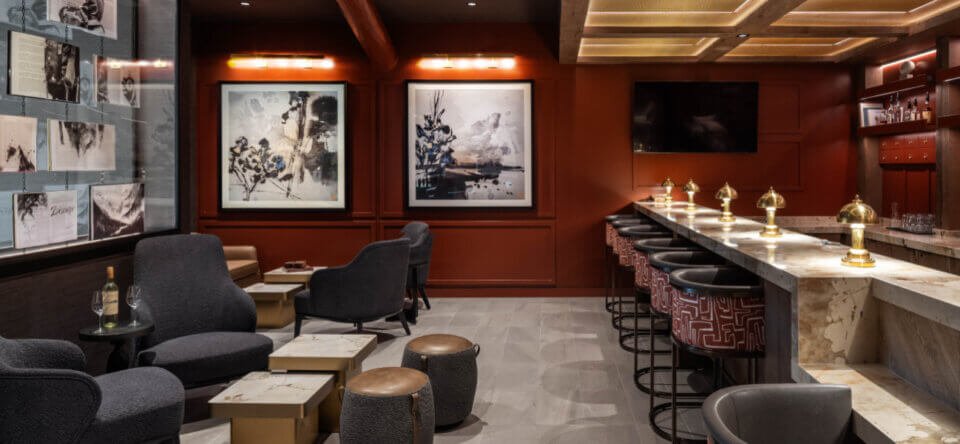
The food and beverage venues received an equally thorough reimagining. “The restaurant and lounge were completely reconceived with a new circulation pattern and cohesive identity,” Thilenius said. “We reoriented the bar to function as a central social hub that transitions from day to night, while softening the restaurant to feel more inviting for both groups and solo travelers.”
Design details reinforce the connection to the land. “Natural finishes and organic shapes echo the surrounding terrain—think stone countertops, leather seating and custom tabletops with live edges and inlaid metal detailing,” Thilenius explained. The bar is anchored by “a bespoke metal canopy structure that visually anchors the space and nods to the mining history of the region.” Materials were selected not just for durability but “for their ability to patina beautifully over time, enhancing the character of the space rather than diminishing it.”
For Thilenius, the guestrooms carried special weight. “The guestrooms are where we felt the most responsibility to create an experience of personal retreat—especially considering that guests here often arrive after a long day of travel or time on the trails,” he said.
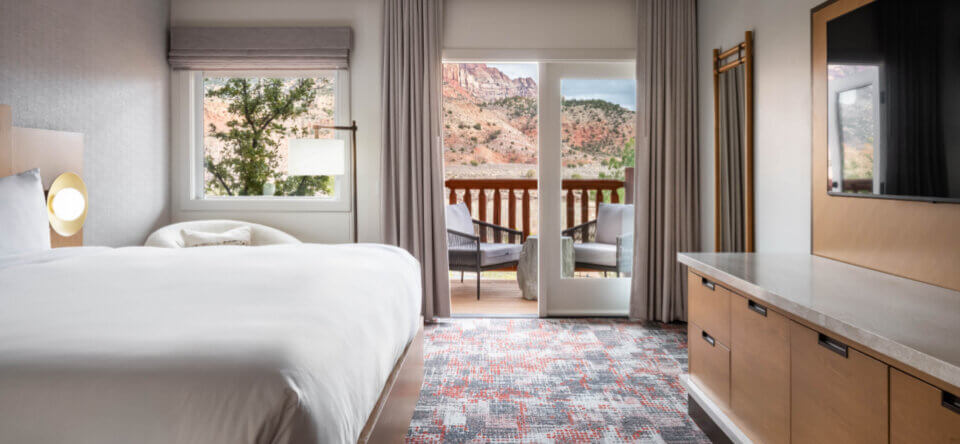
The new design pairs natural materials with a reduced visual palette. “Custom headboards feature wood paneling with subtle carved details that reference sediment layers, while built-in nightstands provide modern convenience and intuitive functionality,” Thilenius said. Storage for hiking gear and workstations for laptops were integrated into custom media units.
Lighting was designed to help guests shift gears. “We incorporated multi-level lighting controls, dimmable sconces and indirect cove lighting to help guests transition from bright desert sun to restful evening ambience,” Thilenius said. Bathrooms now have walk-in showers, stone tile and matte black fixtures “for a modern, spa-like feel.” Textured drapery, wool throws, and locally inspired artwork add what Thilenius called “moments of discovery and comfort,” while ensuring functionality with intuitive storage and convenient charging stations.
From the first view of the cliffs at arrival to the last look from a guestroom window, the renovation of Hotel De Novo Springdale tells a story of place, craft and care. As Thilenius summed it up, the design “unifies the experience and allows nature to remain the hero.”