In today’s competitive hospitality landscape, hotels are increasingly finding new ways to connect with guests beyond the stay itself—and one of the most promising frontiers is retail.
According to David Shove-Brown, partner at Washington, DC-based architecture and design firm //3877, thoughtful retail integration isn’t just about selling souvenirs—it’s about creating a meaningful extension of the guest experience.
“Retail in hotels has had several different lives,” Shove-Brown said. “If you remember back to the earliest markets that had souvenir T-shirts, stale snacks and mass-produced items you could find at any airport newsstand.”
While these basic marketplaces have become standard, Shove-Brown sees an opportunity for hotels to go further—leveraging retail as a tool to strengthen their brand and even add value to underutilized spaces.
“The most successful things that I’ve seen are when the hotel partners up with local artists or designers,” he explained. “Instead of the same T-shirt you can get everywhere, they sell interesting T-shirts or unique things… that you’re not going to find on every street corner.”
He cites The Ramble Hotel in Denver as a standout example. “One of my favorite hotels is The Ramble in Denver, which has a partnership with Death & Company. You can buy their cocktail books, cocktail recipes… from the hotel and the restaurant. It ties in and brings the brand the whole way back.”
These kinds of partnerships do more than just diversify offerings—they bring authenticity and a sense of place into the retail experience. “If you can find some local tie-in, or something that… is again, unique to that hotel or that area—that’s a winner,” Shove-Brown said.
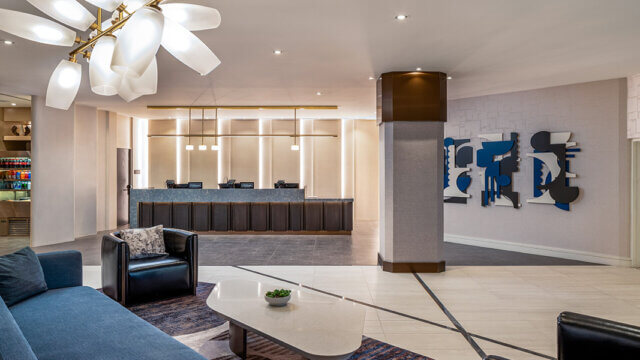
From a design perspective, visibility and accessibility are key to making retail work in a hotel setting. “You need it to be somewhere prominent, where people can see it and experience it and not feel like they’re going to… a back corner closet,” he said. “We look at it from a business and a logistics standpoint, and we try to incorporate… How can we put the market either immediately adjacent to or in very close proximity to the front desk?”
This adjacency isn’t just for convenience—it’s operationally strategic. “The last thing you want to do is go to an owner and go, we’re going to put this little market in here. Oh, by the way, you’ve got to hire two other people to man it.”
By designing with crossover functionality, hotels can create more value without adding overhead. “You want it to be a little bit of a ‘I will get that keychain,’ or ‘I will get that small thing,’ because it’s right here, and it makes life easier.”
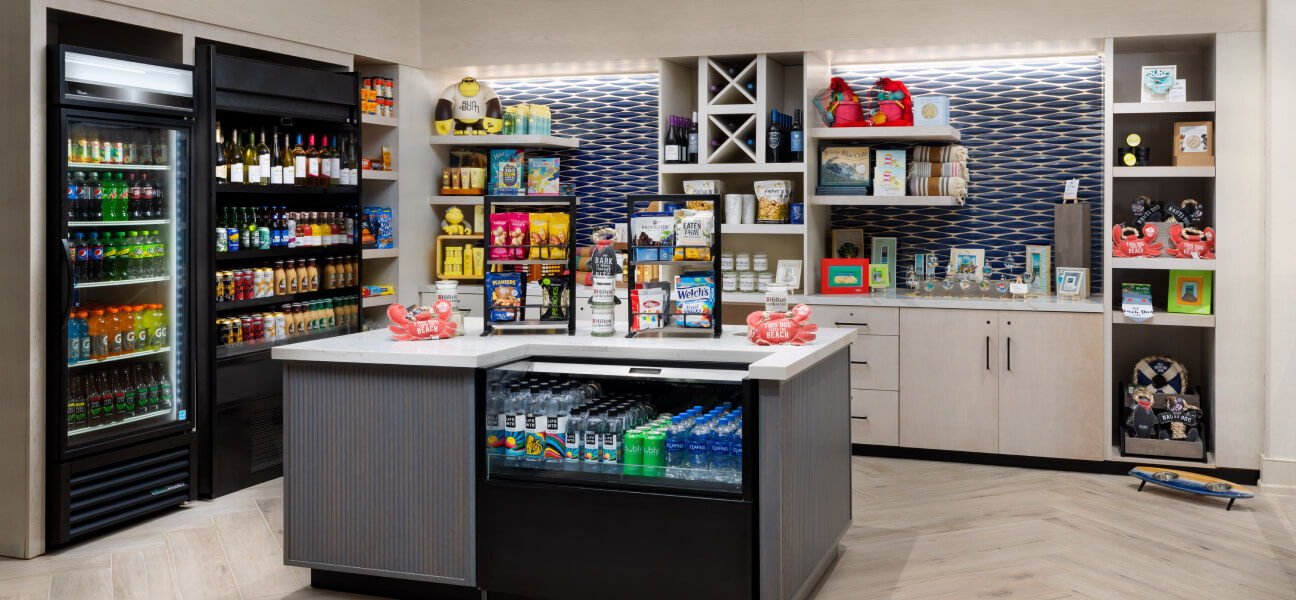
Presentation also matters. “You want to display it so that it feels intentional. It’s not a food market that we also have three shelves of T-shirts,” Shove-Brown added. “Get a mannequin—make it look as intentional as humanly possible, so that it feels like a true retail outlet.”
And for properties without space front and center? Clever signage and display strategies can still make an impact. “You start to look at bigger hotels… hotels are actually incorporating full-on little retail shops. They can lease out, and whether it’s to a local retail shop to open a small satellite and say, ‘Hey, you like what you see here? Go two blocks down the road and you can see more.’”
The benefit is mutual: “Then you start talking about partnerships, because then there’s collateral in the room… you’re just sort of getting a little bit more—not bombarded with information—but… getting even more opportunities in front of guests.”
Shove-Brown emphasized that modern retail in hotels goes beyond goods—it includes services and brand collaborations. “We’re going to put a fitness center in and we’re going to partner up with a yoga studio, and the yoga studio is going to sell their shirt.”
The thinking is simple: “If you don’t sell the gear, they’re going to buy it somewhere else with somebody else’s logo on it.”
Ultimately, hotel retail is about extending the brand through thoughtful design, strategic partnerships, and authenticity. And it can be a solid business decision, too.
“When we developed the Atwell Suites brand prototype, the entire first floor was designed minimizing the amount of additional staff,” he noted. “We’ve got the market area adjacent to the check-in, which is adjacent to the bar… in theory, then you could have on slow times one person selling candy bars, and also can fill your water, but could also cross over when… the bartender is too busy.”